
Our minds are funny, feeble things full of cognitive biases that have been shaped by our experiences, events, and memories.
Over time, these beliefs cause our brains to draw incorrect or false conclusions that ultimately affect the way we think, what we believe, and the decisions we make. Many don’t know how to be real in today’s sociality because our mind is consumed on those things that are mundane.
I once heard someone say that:
“the view you adopt for yourself profoundly affects the way you live your life. It can determine whether you become the person you want to be and whether you accomplish the things you value”.
And the longer I live the more I see this statement become true.
Have you ever heard of the Seligman’s dogs experiment?
If not… it’s basically an experiment behind learned helplessness. It was run by psychologist Martin Seligman and Steven Maier at the University of Pennsylvania. The core finding is that when an animal or person learns that nothing it does affects what happens to it, it often stops trying, even after escape becomes possible. This shows us that we often find ourselves unable to move away from negative situations because our past has taught us that we are helpless to do anything to change how we live or think.
Learned helplessness is behavior typical of an animal and occurs where the subject endures repeatedly painful or otherwise aversive stimuli which it is unable to escape or avoid. After such experience, the organism often fails to learn or accept “escape” or “avoidance” in new situations where such behavior would likely be effective. In other words, the organism learned that it is helpless in situations where there is a presence of aversive stimuli, has accepted that it has lost control, and thus gives up trying. Such leaving the animal or person to now have acquired learned helplessness.
However, the way we react to these negative situations has a profound affect on how we live our lives.
Let’s say, for example, you were turned down for a big contract job. There are a number of things you could tell yourself:
I’m stupid
I’m not meant to be a in this field
I’m a terrible salesperson
The client is a jerk
I had an off day
I didn’t prepare for the interview as well as I should have
I did my best, but the client found someone who was a better fit
What you tell yourself says a lot about the type of person you are.
According to psychologist Carol Dweck, people with a fixed mindset believe that their qualities are set in stone for life and that intelligence and personality are permanent and unchanging. They internalize setbacks with responses like ‘I’m stupid’ or ‘I’m a terrible salesperson’.
‘I failed so I must be a failure’.
On the other hand a person with a growth mindset, believe we can change and grow with effort, application, and experience. They tell themselves that they ‘had an off day’ or ‘didn’t prepare well for the interview’, and perceive their qualities as temporary and external. When you operate in the first mindset by telling yourself the negative. You are carnal minded. When you fail and do something stupid to appease what you just failed in you are carnally minded.
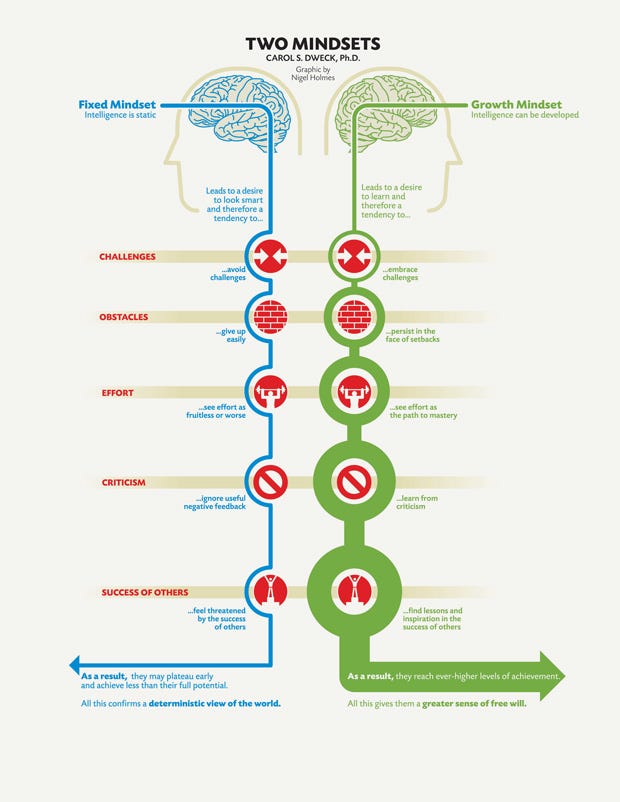
It’s easy to see how years and decades of programming and labeling by our parents, teachers, peers, and even the media teach you to believe certain things about what you’re capable of doing.
I can certainly relate.
I struggle with my own set of cognitive biases and even see these pessimistic patterns emerging in others close to me.
But most of us, myself included, didn’t grow up with parents who proactively cultivated a growth mindset in our malleable little minds, so it’s up to us to reprogram our own brains.
So the first thing I would like you to do if you currently stuck in a fixed mindset and would like to transition to a growth mindset is:
Kill Your Ego
This may be one of the hardest things you ever had to do… but I promise you it will liberate you. When you let go of your desires and attachments to material things and unhealthy relationships… you start killing the ego. The problem is that we become addicted to these relationships out of fear of the emptiness that will replace them if we push them from our minds. However, this becomes a new chance to view life from a fresh set of eyes.
The antidote to learned helplessness is called learned optimism.
Seligman argues in his book Learned Optimism: How to Change Your Mind and Your Life:
“a pessimistic attitude may seem so deeply rooted as to be permanent…[but] I have found that pessimism is escapable. Pessimists can in fact learn to be optimists, and not through mindless devices like whistling a happy tune or mouthing platitudes…but by learning a new set of cognitive skills.”
This is where freedom kicks in. When you kill the ego and set out on the adventure to start learning new cognitive skills. One must first develop self awareness. You can’t get freedom if you are not real about where you are.
Change of any kind is impossible without self awareness. This is the most important components, because when you take responsibility for your weaknesses and shortcomings (while being conscious of your strengths), not only do you see increase but the people around you benefit as well.
A self-aware person help create a culture of ongoing learning and growth, where people understand that it’s okay to make mistakes and ask for help. It’s this kind of growth mindset thinking that leads to innovation and creativity.
So, i’m saying all of this to say… if you want to go from a fixed mindset to a growth mindset you first have to kill the ego. And the last thing i want to leave with you today is:
Stop killing yourself
To jumpstart your own process of change, start with an honest self assessment.
Make a list of the things you believe about yourself and try to determine why you believe these things to be true:
What are your strengths?
What are your weaknesses?
What triggers stress and anxiety?
How do you respond to conflict and adversity?
As you dig through your memories, you’ll likely find that much of the evidence you uncover does not support the assumptions that you’ve been making about yourself.
I’ll write you next Sunday,
- Gold
p.s. Stop killing yourself. Stop thinking you need this and that to function. Stop falling into the same cycle because you refuse to elevate your thinking. Be gentle with yourself.